
ⓘ Skrátka;
- Air India pilot requirements are not a single list — the airline recruits through three completely separate programs: the Cadet Programme for beginners, the Trainee Programme for CPL holders, and direct entry for type-rated experienced pilots, each with its own rulebook that does not overlap with the others.
- The Cadet Programme sets the strictest academic bar among Indian carriers at 60% in 10+2 with PCM and English, but compensates with the most generous age window, up to 30 years, which is the only option for candidates who started later or switched careers.
- A Class 1 Medical Certificate is mandatory for every path and is not a one-time formality — it must be renewed every 12 months under age 40 and every 6 months after, and losing it mid-career ends flying regardless of hours or ratings.
- Height has no minimum requirement. The real standard is functional: you must be able to reach all controls and see clearly over the instrument panel with proper seat adjustment.
- The application runs seven sequential gates — document verification, aptitude test, simulator check, technical interview, personal interview, medical, and final offer — and a gap at any single stage resets the process from the beginning.
Obsah
Searching for Air India pilot requirements usually returns a single list of qualifications. That list is misleading because it collapses three completely different hiring programs into one generic answer.
The confusion costs applicants time and, worse, sends them down the wrong path. A candidate with zero flight hours reading requirements meant for experienced type-rated captains will assume the door is closed. A CPL holder scanning cadet program details will miss the trainee route that actually fits them.
This article separates the three paths, cadet, trainee, and direct entry, with the exact requirements for each. You will know which program matches your current license, hours, and experience. And you will know what to do next.
Three Entry Paths, Three Different Rulebooks
Most guides treat Air India pilot requirements as one list. That is the first mistake.
The airline recruits through three distinct programs. Each has its own rulebook. Blurring them together wastes time and creates confusion.
Pilotný program kadetov is for beginners with zero flight hours. No license needed. No experience required. The airline sponsors the training from scratch.
The Trainee Pilot Programme is for CPL holders. These pilots already have a license and hours. They need airline-specific training on the A320 or B737 fleet.
Direct entry is for experienced pilots. Type-rated captains and first officers on Air India fleet aircraft, A320, B777, B787, A350. These pilots bring operational experience and a current type rating.
Three paths. Three sets of requirements. One airline.
Knowing which path fits is the difference between applying correctly and wasting months on the wrong process.
Cadet Pilot Programme: Requirements for Beginners
Zero flight hours is not a barrier. It is the starting point.
The Cadet Pilot Programme exists for people who have never touched an aircraft. Air India sponsors the training from scratch. The requirements are academic and physical, not experiential.
- 60% in 10+2 with PCM
- 60% in English specifically
- Vek 18 až 30 rokov
- Dobrá znalosť angličtiny
- Dobré fyzické a duševné zdravie
- No prior flying experience
The academic bar is higher than most Indian airlines. IndiGo accepts 55% in graduation. Air India demands 60% in 10+2 with Physics, Chemistry, and Maths. That distinction matters for students still in school.
Check the eligibility page before applying. Gather your 10+2 marksheets and medical records. The age window is twelve years. Do not waste it on preparation that could have started yesterday.
Trainee Pilot Programme: What CPL Holders Need
The Cadet Programme is not the only way in. Air India runs a separate track for pilots who already hold a license but lack the airline-specific training that makes a candidate operational on day one.
This is the Trainee Pilot Programme. It exists because a CPL alone does not prepare a pilot for a 180-seat jet with 150 passengers behind them.
The requirements are specific. A valid Commercial Pilot License issued by the DGCA is non-negotiable. So is a current Class 1 Medical Certificate and an RTR (A) license. The airline also requires a type rating on the A320 or B737, the two aircraft types that make up the bulk of Air India’s narrowbody fleet.
Flight time matters. A minimum of 200 flying hours is required to obtain a Commercial Pilot License under DGCA regulations in India. That is the floor, not the target. Candidates with more hours have a clearer advantage in selection.
The programme is tailored. It bridges the gap between holding a license and being ready for line operations. Training focuses on Air India’s standard operating procedures, cockpit resource management, and the specific systems of the A320 and B737 families.
This path is not for beginners. It is for CPL holders who have done the work but need the airline’s stamp to fly commercially. The question is whether your logbook meets the bar.
Direct Entry: Requirements for Experienced Pilots
Experienced pilots face a different set of hurdles than beginners or CPL holders. The direct entry path is built for speed, get the right pilot into the right seat with minimal retraining. The requirements reflect that urgency.
- Valid CPL or ATPL issued by DGCA
- Aktuálny lekársky preukaz 1. triedy
- Type rating on Air India fleet aircraft (A320, B777, B787, A350)
- Minimum flight hours: 500 to 1,500 depending on role
- RTR (A) license for radio telephony
- DGCA endorsement for foreign license holders
- No upper age limit published for experienced hires
The list hides a key detail. Air India actively recruits foreign pilots with DGCA validation, a move driven by the airline’s rapid fleet expansion. This is not a closed shop for Indian license holders only.
Skontrolovať Air India careers portal for current openings. Prepare your logbook, medical records, and type rating documentation before applying. The window for experienced hires is open, but it will not stay that way forever.
Medical and Physical Standards You Must Meet
The medical exam is where most applicants fail, not the flying. A current Class 1 Medical Certificate from a DGCA-approved doctor is mandatory for every path, cadet, trainee, and direct entry. No certificate, no cockpit.
Vision must be correctable to 6/6 in each eye. Hearing must meet DGCA standards. Cardiovascular health is checked thoroughly. Any disqualifying condition, epilepsy, diabetes requiring insulin, certain psychiatric histories, ends the process before it starts.
Height has no minimum. The question comes up constantly. Air India does not publish a height requirement because there is none. The real standard is functional: you must reach all controls and see over the instrument panel. A shorter pilot with proper seat adjustment passes. A taller pilot who cannot fit the seat fails.
The medical exam is not a one-time event. It must be renewed periodically, typically every 12 months for pilots under 40, every 6 months after that. Each renewal is a fresh assessment, not a rubber stamp. Conditions change. Pilots lose medical clearance mid-career more often than most admit.
This is the gate that stops more applicants than any academic score or flight hour total. The medical is non-negotiable and non-transferable between airlines without revalidation.
Application Process: What Happens After You Apply
Most applicants submit their documents and then wait. That waiting period is where the process actually begins, and it is where most people lose momentum.
The application process for Air India follows a structured sequence of seven steps. Understanding each one before you start is the difference between moving through smoothly and stalling at a stage you did not prepare for.
Krok 1. Submit your online application and all required documents through the Air India careers portal. This includes your educational certificates, license, medical records, and identity proof. Missing a single document here stops everything.
Krok 2. The airline verifies your documents and checks your eligibility against the program requirements. This is a binary gate, pass or fail. If your 10+2 marks fall below the threshold, the process ends here.
Krok 3. A non-technical evaluation follows. This includes a psychometric assessment and an aptitude test designed to measure cognitive ability and decision-making under pressure. The test is standardised and timed.
Krok 4. The technical evaluation is the hardest gate. It involves a simulator check and a technical interview where examiners probe your aircraft knowledge, systems understanding, and procedural discipline. Preparation here means knowing your aircraft manual cold.
Krok 5. A personal interview assesses communication, motivation, and fit for the airline culture. Be ready to explain why you chose this path and what you know about Air India’s current operations.
Krok 6. A medical examination by a DGCA-approved doctor confirms you meet Class 1 standards. This is not a formality, vision, hearing, and cardiovascular health are checked thoroughly.
Krok 7. Final selection and an offer letter. This is the result of passing every prior stage cleanly.
Completing this process unlocks a position with one of the fastest-growing fleets in Asia. The next step is straightforward: check the official careers page for current openings and start gathering your documents today. For a broader view of the industry, read our guide on Ako sa stať pilotom v Indii.
How Air India Pilot Requirements Compare to Other Indian Airlines
Most guides treat every airline’s requirements as interchangeable. They are not.
The differences matter more than the similarities. Air India sets a higher academic floor than any competitor but offers more flexibility on age and experience. Understanding where each airline draws its lines determines which applications are worth submitting.
Výcvik pilotov v Indii starts with knowing which gate is open to you.
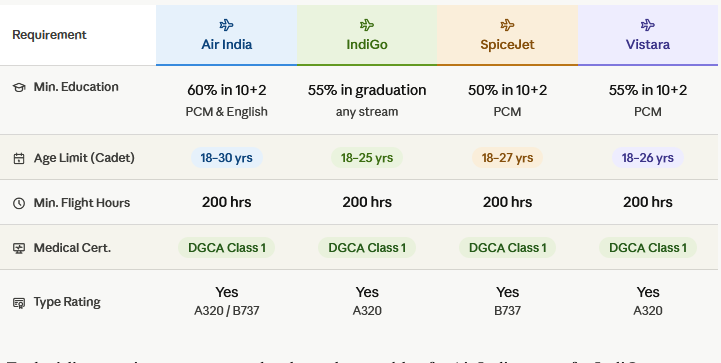
Spoločnosť Air India minimum qualification of 60% in 10+2 with PCM and English is the strictest academic requirement among Indian carriers. IndiGo accepts a graduation degree with 55%, which is a lower bar for students who struggled in science subjects.
But Air India compensates with the most generous age eligibility, up to 30 years for cadets. IndiGo and Vistara cut off at 25 and 26 respectively. For a candidate who started training later or switched careers, Air India is the only option among the four.
The verdict: choose Air India if your academics are strong but your age is pushing limits. Choose IndiGo if your graduation marks are higher than your 10+2 scores. The rest of the requirements are identical across all four airlines.
Your Next Step Toward Flying for Air India
The three paths are not interchangeable. They are gates, and the right one depends entirely on where you stand right now.
Zero hours means the Cadet Programme is the only door. A CPL in hand points to the Trainee route. Type-rated experience opens direct entry. The mistake is applying to the wrong program and wasting months on a rejection that was predictable from the start.
Skontrolovať Air India careers portal for current openings. Prepare your documents before you apply. The difference between a successful application and a stalled one is knowing which path is yours before you start.
Common Questions About Air India Pilot Requirements
What is the qualification for pilot in Air India?
The qualification depends entirely on which entry path you take, the Cadet Programme, the Trainee Programme, or direct entry. For the Cadet Programme, the minimum is 60% in 10+2 with Physics, Chemistry, and Maths plus English, while experienced pilots need a valid CPL or ATPL with a type rating.
What are the requirements for Air India’s pilot program?
Air India runs three separate pilot programs, each with its own rulebook: the Cadet Programme for beginners, the Trainee Programme for CPL holders, and direct entry for experienced type-rated pilots. The Cadet Programme requires no flying experience, while the Trainee Programme demands a minimum of 200 flying hours and a type rating on the A320 or B737.
Can I be a pilot if I’m 5’1″?
Yes, Air India does not enforce a minimum height requirement for pilots. The functional standard is that you must be able to reach all cockpit controls and see clearly over the instrument panel without obstruction.