ⓘ TL;DR
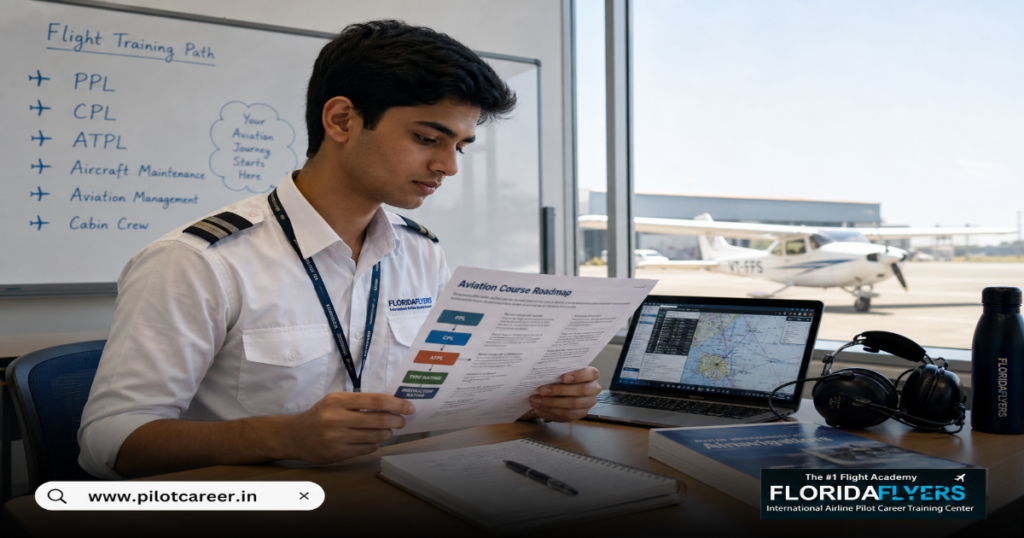
- What Is Aviation Course? It is not just pilot training. It includes pilot programs, aircraft maintenance engineering, aviation management, air traffic control, and cabin crew training.
- Entrenamiento piloto progresses from PPL to CPL to ATPL, while engineering and management programs prepare students for technical and business roles without requiring flight hours.
- Course duration varies widely: a PPL may take a few months, a CPL typically takes 12–18 months, and aviation degree programs can take 3–4 years.
- Requisitos de entrada for pilot courses usually include 10+2 with Physics and Mathematics, medical certification, English proficiency, and financial readiness.
- The right aviation course depends entirely on your career goal. Choosing the wrong path can cost years of time and significant money.
Índice
An aviation course is a category spanning cockpits, control towers, and boardrooms. A program designed for an airline pilot will not prepare you for aircraft maintenance or aviation management.
This article breaks down the types of aviation courses, their durations, and the careers they unlock. You will know which path matches your goal and how to get started.
Consider the student who enrolls in a private pilot course expecting airline transport pilot training. Most discover the difference only after the first tuition payment clears.
Saber la diferencia entre un Parte 61 y Parte 141 program before you start saves months of frustration. The right question is which course is best for your specific end goal.
What an Aviation Course Actually Covers
Most people assume an aviation course is a single track: learn to fly, become a pilot. That assumption is wrong, and it costs people time and money they never get back. An aviation course is a structured program of study that teaches the scientific, technical, and operational knowledge required to work in the aviation industry.
The range is wider than most realize. Some courses put you in a cockpit with hands-on flight training. Others are entirely classroom-based, leading to degrees in aviation management or aerospace engineering. A program like the one at Embry-Riddle Aeronautical University prepares students for piloting, management, and air traffic control roles under one roof.
The distinction matters because the wrong course wastes years. A student who wants to manage airline operations does not need flight hours. A student who wants to fly commercially does not need a four-year management degree. The course must match the destination.
Understanding this range changes how you evaluate programs. You stop asking “Is this a good aviation course?” and start asking “Does this course lead to the job I actually want?” That shift separates a smart investment from an expensive detour.
Consider the difference between a flight training course and an aviation management degree. One builds muscle memory in a cockpit. The other builds spreadsheets and regulatory knowledge. Both call themselves aviation courses. Both are correct. But they serve entirely different people.
This is where most students get stuck. They search for a single answer to “what is aviation course” and find a list of programs that all sound similar. The real question is not what the course covers in general. It is what the course covers for you.
Types of Aviation Courses: Pilot, Engineering, Management, and Cabin Crew
Not every aviation course puts you in a cockpit. The industry has four distinct career lanes, each requiring a different kind of training and leading to a different kind of work. Understanding these categories is the first real decision you make about your future.
Pilot Training: From Private License to Airline Transport
Pilot training is the most visible path and the one most people picture when they ask what is aviation course. It starts with a Private Pilot License (PPL) and builds through a commercial pilot license course to an Airline Transport Pilot License (ATPL). Each stage adds privileges and complexity. Florida Flyers Flight Academy specializes in this exact progression, offering programs from PPL through ATP with structured ground school and flight hours.
Aviation Engineering: Keeping Aircraft in the Air
Aircraft Maintenance Engineering (AME) and B.Tech in Aviation are technical programs that train specialists to inspect, repair, and certify aircraft. These courses focus on airframes, engines, and avionics systems. Graduates work in maintenance hangars and repair stations, not in the cockpit. The work is methodical, safety-critical, and in constant demand.
Aviation Management: Running the Business of Flight
BBA and MBA programs in Aviation Management prepare students for the operational and strategic side of the industry. Airlines, airports, and charter companies need people who understand scheduling, fleet planning, regulatory compliance, and customer experience. These degrees lead to roles in operations, marketing, and executive leadership, no flight hours required.
Cabin Crew Training: Safety and Service at Altitude
Cabin crew programs teach emergency procedures, passenger management, and in-flight service protocols. The training is shorter than pilot or engineering courses, typically lasting a few months. Graduates work directly with passengers on commercial flights. It is a people-facing role that demands composure under pressure and a thorough understanding of aviation safety regulations.
Entry Requirements for Aviation Courses: What You Need Before You Apply
The hardest part of starting an aviation course happens before you ever sit in a cockpit. Entry requirements vary wildly by course type, and missing one can delay your application by months.
- Age minimum. Most aviation courses require you to be at least 17 years old before you begin flight training or enroll in a degree program.
- Educational background. Pilot courses demand 10+2 with Physics and Mathematics as compulsory subjects. Management and cabin crew programs accept a wider range of streams.
- Medical fitness. A Class 1 medical certificate is mandatory for commercial pilot training. Class 2 medicals cover private pilots and some non-flying roles.
- Language proficiency. English is the international language of aviation. Schools require proof of proficiency through IELTS, TOEFL, or a similar assessment for non-native speakers.
- Passport and visa eligibility. International students need a valid passport and an M1 visa for US-based flight training. Florida Flyers Flight Academy is authorized to sponsor this visa for qualified applicants.
- Background checks. Some courses, especially those involving airport access or security clearance, require a clean criminal record and a background verification.
- Financial proof. Aviation training is expensive. Schools often ask for bank statements or sponsorship letters to confirm you can cover tuition and living costs.
Academic and medical prerequisites are non-negotiable for pilot courses. The rest, language, visa, finances, are logistical hurdles solvable with planning.
Start by confirming the medical and education requirements for your chosen path. Then check visa rules if you are training abroad. A curso piloto en India may have different prerequisites than one in the US or Europe. Know the difference before you apply.
How Long Does an Aviation Course Take? Comparing Durations by Path
Duration is the variable most people get wrong when asking what is aviation course. A Private Pilot License wraps up in a matter of months. A Commercial Pilot License demands a full year or more. A B.Sc. in Aviation stretches across three years. The real question is not which is fastest, it is which fits your end goal.
A PPL is the shortest path. It teaches the fundamentals of flying a single-engine aircraft. The trade-off is stark: a PPL alone qualifies you to fly for recreation, not for hire. You cannot earn money with it. That makes it a stepping stone, not a destination.
A CPL is the standard entry ticket for professional pilots. It builds on the PPL with advanced navigation, multi-engine operations, and instrument flying. The extra months matter because airlines and charter operators demand that depth. This is where intensive pilot training India programs earn their value, they compress the timeline without cutting corners.
A B.Sc. in Aviation is a different animal entirely. It is an undergraduate degree that combines flight training with academic coursework in aerodynamics, meteorology, and aviation law. The three-year commitment opens doors beyond the cockpit, airline management, regulatory roles, and further study. The trade-off is that you spend years in classrooms before logging serious flight hours. For someone set on flying, that delay can feel like a penalty.
Academia de vuelo Florida Flyers offers fast-track programs that collapse the timeline to a CPL without sacrificing the structured aviation degree foundation. The right choice depends on one thing: whether you need a job this year or a career with broader options a few years from now. Speed wins when you know exactly where you are headed. Depth wins when you are still figuring it out.
The Misconception That All Aviation Courses Lead to the Cockpit
The most persistent myth about aviation training is that every course exists to put someone in the left seat of an airliner. This assumption costs talented people years of lost opportunity. They walk into a flight school because they think that is the only door, when the industry actually needs engineers, managers, air traffic controllers, and cabin crew just as urgently.
An aviation technology program trains students for careers with commercial airlines, regional airlines, and charter operations, none of which require a pilot’s license. The curriculum covers aircraft systems, maintenance procedures, and operational logistics. Graduates walk into roles that keep planes flying without ever touching the yoke.
The industry does not run on pilots alone. Every flight that departs needs a certified mechanic who signed off on the airframe. Every route network needs a manager who understands fleet utilization and crew scheduling. Every approach needs a controller who can sequence traffic through busy airspace. These careers pay well, offer stability, and require no flight hours.
Programs like the one offered by Colegio Comunitario del Condado de Allegheny demonstrate this reality clearly. Their aviation technology track produces graduates who work in maintenance, operations, and management for major carriers. The training is hands-on, the outcomes are concrete, and the cockpit is never the goal.
For students in India, this distinction matters even more. An aviation degree in India opens doors to airline management, airport operations, and regulatory roles that have nothing to do with flying. The reader who assumes every aviation course is a pilot course is closing off options they never knew existed.
Consider the controller who sequences arrivals at Mumbai’s Chhatrapati Shivaji Maharaj International Airport. That career requires a separate certification pathway, not a pilot’s license. The training is rigorous, the salary is competitive, and the job security is high.
The same logic applies to airport operations managers. They coordinate ground handling, security protocols, and terminal logistics for carriers like IndiGo and Air India. These roles demand aviation knowledge without ever requiring flight time in a logbook.
Career Paths After an Aviation Course: Where Your Training Takes You
The course you choose writes the first chapter of your career. A pilot training path and an aviation management degree lead to entirely different worlds, and the gap between them is where most people waste time and money. Your training must match your target role, not your vague interest in aviation.
Piloto comercial: This is the most visible outcome. A structured CPL program with ground school and multi-engine training prepares you for airlines, charter operators, and cargo carriers. Employers range from regional carriers to major international airlines.
Instructor de vuelo: Many pilots teach to build hours before moving to the airlines. A Curso de instructor de vuelo en India is a direct path to earning while logging the flight time required for ATP certification. It is a teaching role, but it is also a career accelerator.
Aircraft Maintenance Engineer: AME programs train specialists who inspect, repair, and certify aircraft. Airlines, MRO facilities, and private operators depend on these engineers to keep fleets airworthy. It is a technical career that does not involve flying.
Aviation Manager: Airport operations, airline scheduling, and regulatory compliance need managers who understand the business side. A BBA or MBA in aviation management leads to roles in airline headquarters, airport authorities, and logistics companies.
Controlador de tráfico aéreo: This role requires specialized training in radar procedures, communication protocols, and emergency response. Controllers work for civil aviation authorities and manage the safe movement of aircraft in airspace and on runways.
Each path demands a different kind of preparation. The reader who wants to fly must choose a CPL program with structured training. Florida Flyers Flight Academy builds programs that move students from zero experience to commercial pilot and flight instructor status. The right course eliminates detours. The wrong one costs years.
Choosing the Right Aviation Course for Your Goals
The best aviation course is not the most famous one. It is the one that matches a specific career goal, a realistic budget, and a clear timeline. A program that works for someone aiming to fly for a regional airline will fail for someone who wants to manage airport operations.
For aspiring pilots, the path is straightforward. A structured CPL program that includes ground school and flight hours builds the foundation for a professional career. Look for schools that offer integrated training, where theory and flying happen in parallel, not in separate silos. The wrong sequence wastes time and money.
For those drawn to the business side of aviation, an aviation management degree opens different doors. These programs cover airline economics, regulatory frameworks, and operational strategy. Graduates work in airline planning, airport management, and cargo logistics. The cockpit is not the only destination. Researching schools requires more than reading a brochure. Check accreditation with the relevant civil aviation authority. Visit the campus if possible. Talk to current students about their experience.
Florida Flyers Flight Academy offers a fixed-price career program designed for aspiring pilots who want a clear path from zero experience to a commercial license. The program bundles ground school, flight training, and checkride preparation into a single cost. No surprise fees. No hidden charges. For students exploring options, reviewing different aviation pilot courses side by side reveals which ones align with their goals and which ones do not.
Your Next Step in Aviation
The framework is now clear. An aviation course is not a single decision, it is a category with many paths, and you now know which questions to ask before choosing one.
Every week someone signs up for a program that does not match their goal. They spend months in a classroom when they should be in a cockpit, or they chase a pilot license when their real talent lies in management or engineering. That mismatch costs time and money that cannot be recovered.
Research the specific course that matches your career goal. Check the entry requirements. Verify the school’s accreditation. Then apply to a program that actually takes you where you want to go.
Frequently Asked Questions About Aviation Courses
What is an aviation course?
An aviation course is a structured training or academic program that prepares students for careers in the aviation industry. These programs include pilot training, aircraft maintenance engineering, aviation management, air traffic control, and cabin crew training.
What are the main types of aviation courses?
The main types of aviation courses include pilot training programs (PPL, CPL, ATPL), aircraft maintenance engineering (AME), aviation management degrees (BBA or MBA), and cabin crew training. Each path leads to a different aviation career.
How long does an aviation course take?
The duration depends on the program. A Private Pilot License may take a few months, a Commercial Pilot License typically requires 12 to 18 months, cabin crew programs last several months, and aviation degree programs can take three to four years.
What are the entry requirements for pilot training courses?
Pilot training usually requires completion of 10+2 with Physics and Mathematics, a valid Class 1 or Class 2 medical certificate, English language proficiency, and proof of financial capability to cover training costs.
Do all aviation courses lead to becoming a pilot?
No. Many aviation courses lead to careers in aircraft maintenance, airline operations, airport management, air traffic control, and cabin crew services. Only structured pilot training programs lead directly to flying roles.