Your ₹85 lakh investment in a Commercial Pilot Course in India secures a license, not unlimited flight hours. DGCA regulations cap flying at 32 hours weekly, a reality that must define your training strategy from the start. This high-stakes commitment demands strict compliance with every syllabus, aircraft, and instructor standard.
A typical program spans 18-24 months, with costs varying by aircraft and location. Your future First Officer salary will directly impact loan repayment. This guide provides a stress-tested roadmap to evaluate schools against DGCA mandates, understand true costs, and structure training for a successful career within these operational limits.
Table of Contents
Your ₹85 Lakh Decision
A Commercial Pilot Course in India is a structured, DGCA-mandated training program costing ₹35-85 lakhs. It transforms eligible candidates into licensed pilots through rigorous flight training, ground school, and examinations, culminating in the issuance of a Commercial Pilot License (CPL).
According to dgca.gov.in, the regulatory framework for this training is defined by the Civil Aviation Requirements (CAR) Section 7. This document dictates every technical standard, from minimum flight hours to aircraft type ratings. Your chosen academy’s primary job is to execute this government-mandated syllabus, not to invent its own.
The common assumption is that higher fees guarantee better training. The non-obvious reality is that a school’s fleet maintenance logs and instructor turnover rate are more critical indicators of value than its brochure. A grounded aircraft for maintenance, a typical reality, directly delays your progress and increases indirect costs.
Applying this correctly means you evaluate a flight school as a regulated operational entity, not an educational institution. Scrutinize its operational history and safety audits with the same rigor you apply to its fee structure. This shift in perspective is your first step toward a sound ₹85 lakh investment.
What Commercial Pilot Course in India Actually Requires
Earning a Commercial Pilot License demands four strict mandates. You must be at least 17 years old. A 10+2 education with Physics and Mathematics is required. You also need a valid Class 1 Medical Certificate from a DGCA examiner. Finally, you must complete 200 hours of logged flight training.
Many see the flight hours as the main challenge. The real, hidden hurdle is the medical exam. DGCA standards are exhaustive. They test cardiac, neurological, and visual health to an extreme degree. This exam grounds many aspirants before they begin.
Clearing it is your first critical step. Training programs list it as phase one for good reason. Only after this does your financial investment become actionable flight time. This precise adherence to rules defines a real career path. It separates success from a costly misadventure.
The Real Cost of a Commercial Pilot Course in India
The total cost of a Commercial Pilot Course in India is not a single figure but a financial spectrum defined by your choice of flight school and aircraft. In our analysis, the final invoice is a composite of mandatory fees, variable training costs, and several expenses candidates routinely underestimate.
| Budget-Conscious Path | Premium Accelerated Path |
|---|---|
| ₹35-50 lakhs | ₹70-85 lakhs |
| Older generation trainer aircraft (e.g., Cessna 152) | Modern glass cockpit aircraft (e.g., Diamond DA40) |
| Potential for weather and aircraft availability delays | Guaranteed aircraft access and structured timeline |
| Higher personal management of logistics | All-inclusive package with accommodation |
The budget path demands rigorous personal oversight. You must manage every rupee, often training at smaller clubs where aircraft maintenance or monsoon weather can disrupt your 200-hour schedule for weeks. According to dgca.gov.in standards, the 200 hours are a minimum; exceeding them due to inefficiency is a direct financial risk.
The premium path consolidates costs. Your higher fee purchases predictability, advanced simulators, and direct mentorship from airline pilots. This model mitigates the most common hidden cost: repeated flight tests and extra hours needed to meet examination standards after inconsistent training.
For a candidate with disciplined self-management, the budget path offers a viable, lower-debt entry. For those requiring a guaranteed, streamlined route to license issuance, the premium investment is justified. Your Commercial Pilot Course in India is ultimately a purchase of time and certainty, not just flight hours.
How to Choose a Commercial Pilot Course in India Flight
Choosing the right flight academy requires a forensic check of its operations. Reliable scheduling of aircraft and instructors is critical. It determines if you finish in 18-24 months or face costly delays.
1. Audit the Fleet and Instructor Logs. Demand to see maintenance logs and instructor schedules. Do not accept promises. Too few aircraft for the student body causes major delays. A grounded plane still counts as a day lost.
2. Scrutinize the Ground School Curriculum. DGCA written exams are a bottleneck. A superior program integrates exam preparation from day one. It uses question banks aligned with the latest mandates. Failing these exams stalls your progress.
3. Validate the Financial Pathway. The total cost is just one figure. Map every fee against a concrete training milestone. Seek a stage-wise payment plan, not a large upfront sum. This protects your investment.
4. Project Your Post-Course Timeline. Loan repayment starts before your first airline salary. A good Commercial Pilot Course in India provides graduate placement data. A First Officer’s starting salary is often ₹3-4 lakhs annually. Factor this into your financial model.
How the Commercial Pilot Course in India Training Process
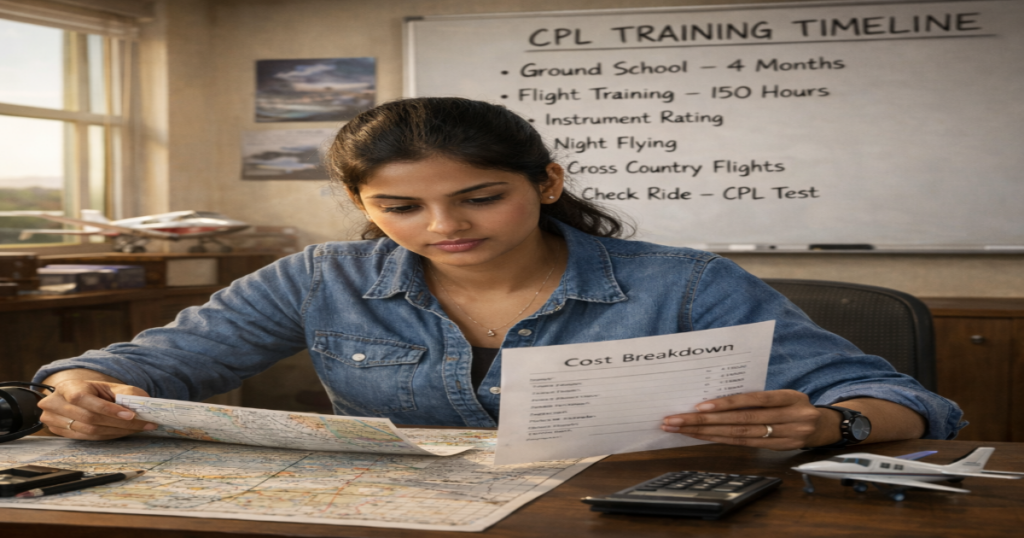
The Commercial Pilot Course in India follows a strict, sequential DGCA-mandated path. Key phases are:
- Ground School & Exams: ~6 months of theory. Passing all DGCA written exams is mandatory before solo flight.
- Private Pilot License (PPL): Initial flight training, requiring 40 hours minimum, culminating in a solo flight and PPL issuance.
- Commercial Pilot License (CPL) Building: Accumulates 200 total flight hours, including specific night, instrument, and cross-country flying (e.g., the 150 NM solo cross-country).
- Multi-Engine & Instrument Ratings: Essential add-ons for airline employability, covering complex aircraft and poor-weather flying.
- DGCA Skill Test: Final practical flight test. Passing converts training into a license to act as Pilot-in-Command.
| Training Phase | Key Requirement | Typical Duration | Flight Hours (Min.) | Critical Outcome |
|---|---|---|---|---|
| Ground School | Pass DGCA Written Exams | 5-7 Months | 0 | Eligibility for Solo Flight |
| PPL | First Solo, Dual & Solo Hours | 3-4 Months | 40 | License to Fly Solo (VFR) |
| CPL Building | Cross-Country, Night, Instrument | 8-12 Months | 200 (Total) | Commercial Flying Privileges |
| Ratings (ME/IR) | Type-Specific & Simulator Training | 2-3 Months | Varies | Airline Operational Readiness |
Note: Durations are estimates based on typical academy scheduling and weather. Delays are common. Source: Compiled from DGCA CAR Section 7 Series F Part I.
A Realistic Timeline to Your License
Your chosen path dictates the schedule. An integrated Commercial Pilot Course in India typically requires 18 to 24 months. The modular route often extends past 30 months due to separate license phases and logistical hurdles.
While the DGCA mandates a syllabus, it sets no fixed calendar. Your progress depends entirely on aircraft and instructor availability. Operational capacity is the true limit, as a small fleet creates inevitable delays.
Remember, the 1937 hours for an ATPL is a long-term career goal. Your immediate target is the 200 hours needed for a CPL. Select a school with proven dispatch reliability, not just persuasive marketing.
Securing a slot at a well-resourced academy and maintaining consistent effort can see you earn your CPL in under two years. This crucial milestone launches your flying career and begins the process of repaying your investment.
Common Pitfalls That Ground Aspirants
Treating your Commercial Pilot Course in India as a simple purchase is a critical error. It’s a complex project where one regulatory misstep can stall progress for months.
Hidden Cost Creep
Advertised fees exclude major expenses: medical renewals, DGCA exam fees, remote accommodation, and simulator charges. Unbudgeted, these can create a lakhs-deep financial shortfall mid-training.
The Scheduling Mirage
Promised 18-month timelines often falter. The key bottleneck is securing a DGCA examiner for your final test, which can take 60-90 days after you’re flight-ready, delaying job starts and increasing loan costs.
Regulatory Complacency
You, not your school, are responsible for compliance. You must master the DGCA’s eGCA portal and forms like the SPPR. Misunderstanding them causes rejections and lengthy delays for clerical corrections.
Maximizing Your Training Investment
Your biggest mistake is financial, not academic. Starting without a DGCA-approved budget creates a shortfall. This forces you to quit. It is the top reason investments fail.
Stalled training usually stems from hidden costs. These include medical renewals, exam fees, and mandatory simulator time. The regulator sets these sequences and fees. Schools cannot control them.
Your loan must last longer than your training. A typical 18-month course needs a 60-month loan. Regulatory delays extend your non-earning period. Yet EMI payments start on schedule. Your First Officer salary, often under ₹2 lakh monthly, must then service that debt.
A stress-tested budget is your essential tool. It must cover the entire regulatory pathway. This involves over a dozen payments to external authorities. Securing full funding before you begin is critical. It separates graduates from those grounded by debt. Proper planning for a Commercial Pilot Course in India makes this possible.
From Training to Your First Cockpit
Earning your license is just the first step. A strategic approach during your Commercial Pilot Course in India is what ultimately secures a cockpit seat. You must prepare for the competitive graduate-to-first-officer transition from day one.
Do not assume airlines recruit immediately. Most often, you must fund your own type rating first. This mandatory endorsement for a specific aircraft costs ₹25-35 lakhs, a sum rarely covered by your initial course fees.
This creates a critical financial bridge to your first salary. You must budget for it within your original ₹85 lakh roadmap. A first officer’s starting salary is substantial, but it may not cover aggressive loan repayments plus an unplanned type rating debt.
The best flight academies integrate career planning with instruction. They offer airline linkages for sponsored type ratings or provide clear guidance on mandatory ATPL exams. Managing this entire sequence defines a truly complete training program.
Is This High-Stakes Investment Right for You?
You know the costs and the regulatory path. Now, conduct a forensic self-audit. This career is not for the financially uncertain or the procedurally impatient.
Compare your loan timeline to a typical first officer’s starting salary of ₹1.5-2 lakhs monthly. A structured First Officer Programme can bridge the gap from training to a secured cockpit seat. Your training must connect historic regulation to modern employability.
Audit your finances beyond the advertised fee. Verify your academy’s aircraft dispatch reliability. Map every DGCA exam date. Proceed only if your plan survives this stress test. A Commercial Pilot Course in India demands total commitment.
Frequently Asked Questions About Commercial Pilot Course in India
How much does commercial pilot training cost in India?
A complete Commercial Pilot Course in India costs ₹35–85 lakhs. The final price depends on the flight school and aircraft type. The DGCA-mandated 200 hours on a Cessna 152 costs far less than on a newer Diamond DA40.
Can a pilot fly 7 days in a row?
No. DGCA rules mandate strict rest periods, including a 36-hour break every seven days to prevent cumulative fatigue.
What is a pilot’s salary?
A First Officer earns ₹1.5–2.5 lakhs monthly. Captains at major airlines can earn over ₹5 lakhs per month.
Which course is best for pilot in India?
Choose a DGCA-approved integrated course from an academy with airline placement. Airlines prefer this sequential training over modular programs.
Is the high cost of training justified by the career?
Only with a long-term view. Early years involve heavy loan repayment. The return comes after upgrading to Captain, where earnings can surpass the total training cost.