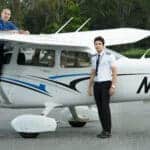

You’ve logged the hours. You’ve passed your DGCA exams. But there’s still one thing standing between you and your pilot license: the DGCA checkride.
And this isn’t just another flight.
It’s the flight that decides whether you’re truly ready to fly solo, take command, and earn your wings. One examiner. One aircraft. One chance to prove that everything you’ve learned—from cockpit flows to emergency procedures—can be executed with skill, confidence, and safety under pressure.
For most student pilots, the checkride feels like the final boss. It’s intense. It’s unpredictable. And it’s absolutely passable—if you’re prepared.
This guide walks you through exactly what to expect in a DGCA checkride, including the oral exam, in-flight maneuvers, common traps that cause failures, and proven tips to help you pass on the first attempt.
If you’re training in India and working toward your CPL, PPL, or even an ATPL, this is the checklist you didn’t know you needed—until now.
What Is the DGCA Checkride?
The DGCA checkride is the final assessment every pilot in India must pass to earn a flying license—whether it’s for a Private Pilot License (PPL), Commercial Pilot License (CPL), or Airline Transport Pilot License (ATPL).
It’s conducted by a DGCA-authorized flight examiner and consists of two parts: a detailed oral exam and a practical in-flight test. Together, these evaluate your theoretical knowledge, flying skills, and decision-making under real cockpit pressure.
You’ll be tested on everything from aircraft systems, emergency procedures, and meteorology, to practical flying maneuvers like steep turns, stalls, navigation, and landings. It’s your opportunity to demonstrate not just skill, but command presence and safety awareness.
The aircraft used is usually a single-engine trainer like the Cessna 172 or Piper Warrior—familiar machines for most Indian flight students. But don’t be fooled by routine. The examiner is watching everything: how you brief, how you think, how you recover from surprises.
This isn’t a formality. The DGCA checkride is a high-stakes, pass-or-fail test that proves you’re ready to operate as pilot-in-command. Understanding the structure and expectations is the first step toward acing it.
DGCA Checkride Requirements and Eligibility
Before you can even schedule your DGCA checkride, you need to meet a few non-negotiable requirements. These aren’t just paperwork—they’re proof that you’ve completed every step leading up to this point.
Minimum Flight Hours: For a Commercial Pilot License (CPL), you must log a minimum of 200 total flight hours—including specified hours for solo, cross-country, and instrument flying. For a Private Pilot License (PPL), it’s typically 40 to 50 hours, depending on your training path.
Passed All Required Theory Exams: The checkride can only be attempted after passing DGCA’s written exams in subjects like Air Navigation, Meteorology, Technical General, and Air Regulations. These scores must be valid at the time of your test.
Valid Medical Certificate: You’ll need a Class 1 medical certificate (for CPL) or Class 2 (for PPL), issued by a DGCA-approved medical examiner.
Aircraft and Logbook Readiness: Your logbook must be up to date and properly signed by instructors. The aircraft you’ll use for the test must also be airworthy, with current documentation and technical logs in order.
Slot Booking: The checkride must be scheduled through your flight school or directly with a DGCA-approved examiner, depending on availability and region.
Meeting these eligibility criteria ensures that when test day arrives, you’re not scrambling with paperwork—you’re focused on flying.
DGCA Oral Exam – What to Expect
Before you even touch the aircraft, your DGCA checkride begins with an oral exam. And make no mistake — this part is just as important as the flight.
The examiner will sit down with you and start asking questions to assess your understanding of flight theory, aircraft systems, rules, and decision-making. This is where your depth of knowledge really shows. It’s not about memorizing answers — it’s about proving you know how to think like a pilot.
Here’s what they typically cover:
- Air Navigation – calculating headings, drift corrections, fuel planning, and diversion techniques
- Meteorology – interpreting METARs and TAFs, cloud types, wind shear risks, and weather deviations
- Air Regulations – flight rules, airspace classification, ATC procedures, and emergency protocols
- Aircraft Systems – engine types, electrical systems, fuel system layout, and limitations specific to your aircraft
- Weight & Balance – calculating center of gravity and ensuring aircraft is within limits
- Flight Planning – preparing a full nav log and demonstrating how you built your route
Expect follow-up questions. The examiner may throw in a “what if” scenario: “What if your alternator fails 20 NM into the flight?” Your response should reflect logic, safety, and confidence.
The tone may feel relaxed, but the assessment is real. Your answers set the tone for the flight portion. If you’re unsure, say so — but always explain your thinking.
Nailing the oral exam proves you’re not just someone who can fly—you’re someone who understands why things work, how to troubleshoot, and when to take command.
Flight Maneuvers Tested During the Checkride
Once the oral exam is complete, it’s time to get airborne. The flying portion of your DGCA checkride is where you prove you can translate theory into real-world control, precision, and judgment.
Your examiner will observe how you handle the aircraft in normal, abnormal, and simulated emergency conditions. But here’s the truth: they’re not looking for perfection—they’re watching how you manage workload, stay composed, and prioritize safety.
Here are the core maneuvers you’re likely to be tested on:
Steep Turns: Maintain altitude, speed, and coordinated flight through 45°–60° banked turns. Show your ability to anticipate and correct.
Stall Recognition and Recovery: Demonstrate full recovery from power-on and power-off stalls, with minimal altitude loss. Emphasis is on recognizing the buffet and responding without delay.
Slow Flight: Fly the aircraft at the edge of a stall—controlling pitch and power to maintain altitude and heading. A true test of finesse.
Normal and Flapless Landings: Approach and land smoothly under both normal and no-flap conditions. You’ll also likely demonstrate a glide approach.
Diversion to Alternate: Mid-flight, the examiner may ask you to divert to a new destination. This checks your ability to recalculate heading, distance, ETA, and fuel on the fly.
Navigation Check: Follow a pre-planned route using your nav log. Accurate checkpoint timing and altitude discipline are key here.
Forced Landing (Simulated Engine Failure): Engine failure? Pitch for best glide, pick a suitable landing site, go through emergency checks, and brief your plan. You’ll likely conduct this from 2,000–3,000 feet AGL.
Throughout the flight, don’t guess. If something seems off, verbalize it. Use checklists. Fly safely. And remember: the examiner isn’t trying to trick you. They want to see how you think as much as how you fly.
Common DGCA Checkride Mistakes Students Make
A lot of students fail the DGCA checkride not because they don’t know how to fly—but because they let pressure get the best of them. The nerves kick in, the basics fall apart, and suddenly a routine maneuver turns into a bust.
Here are some of the most common mistakes that cost students their checkride—and how to avoid them:
1. Skipping Proper Briefings: Many students rush into the flight without briefing their takeoff, emergencies, or alternate plans. This shows poor cockpit discipline and weak preparation. Always brief like a pro, even if it feels repetitive.
2. Rushing Maneuvers: Whether it’s a steep turn or a stall recovery, rushing leads to overcontrol or missed cues. Take a breath. Fly smooth and deliberate. Your examiner isn’t timing you—they’re judging your technique and safety awareness.
3. Ignoring Checklists: Skipping checklist flow is a major red flag. The examiner wants to see that your cockpit flow is structured and consistent. Commit your flows to memory, but still confirm using written checklists.
4. Poor Situational Awareness: Losing track of position, heading, or altitude is a warning sign. In the air, you should always know where you are, where you’re going, and what comes next.
5. Panicking Under Pressure: You make a mistake—now what? Many students spiral after a minor error. The key is to recover, stay composed, and keep flying. Most examiners won’t fail you for one small slip. But losing your cool? That’s harder to ignore.
Your goal during the DGCA checkride isn’t to be flawless. It’s to be safe, structured, and confident—even when something doesn’t go to plan.
What Happens If You Fail the DGCA Checkride?
Failing the DGCA checkride can feel devastating—but it’s not the end of your flying career. It happens more often than most students admit, and the DGCA has a clear path for retesting.
If the examiner feels your performance wasn’t up to standard—either during the oral or flight segment—they’ll explain where you went wrong. You’ll receive a debrief outlining the areas you need to improve before your next attempt.
You’re typically allowed to reattempt the checkride after additional instruction and sign-off from your flight school or instructor. The number of rechecks isn’t strictly limited, but repeated failures could delay your licensing process and affect your confidence—so take the feedback seriously.
Most failures come down to one of three things: poor preparation, nerves, or weak decision-making. The fix? Practice, simulate the checkride environment with your CFI, and train until your responses become instinctive.
One failed checkride doesn’t define you as a pilot. What matters is how you bounce back, improve, and return more focused the second time.
Tips to Pass Your DGCA Checkride on the First Attempt
The DGCA checkride isn’t about flying like a superhero—it’s about flying with skill, discipline, and sound judgment. Examiners aren’t expecting perfection. They’re looking for a pilot who can think clearly, fly safely, and manage real cockpit situations without losing control—mentally or physically.
Here are practical tips that go deeper than the usual surface-level advice:
Rehearse the Entire Checkride in Advance: Don’t just review maneuvers. Practice the full checkride sequence—from oral questioning to pre-flight inspection to in-air navigation and emergency procedures. Have your instructor run mock checkrides that simulate real pressure. This builds muscle memory and reduces performance anxiety on the actual test day.
Know Your Aircraft Systems Inside-Out: Expect detailed questions about your aircraft. How does the fuel system work? What happens if your alternator fails mid-flight? What’s the electrical bus layout? Don’t rely on vague textbook answers—learn from your actual aircraft POH and systems diagram so you can explain things confidently and practically.
Fly Predictably, Not Perfectly: The examiner doesn’t want fancy flying. They want consistency. Level off smoothly. Make coordinated turns. Stick to your altitudes and headings. If you drift, correct gently—not aggressively. Sloppy flying shows a lack of control. Smooth flying shows professionalism.
Talk Through Your Actions: Verbalize what you’re doing and why. Say things like, “Turning to intercept the radial,” or “Reducing power to enter slow flight.” This gives the examiner insight into your thought process, even if a maneuver isn’t perfect. It also shows that you’re actively managing the flight.
Don’t Panic Over Small Mistakes: Everyone makes minor errors. What matters is how you recover. If you overshoot an altitude or heading, acknowledge it and correct immediately with calm control. The checkride is not failed because of a mistake—but it can be failed if you freeze or overcorrect.
Nail Your Checklists and Flows: Many students forget or rush through checklists. Big mistake. The examiner wants to see that you use checklists with discipline. Internalize the flow (e.g., downwind checks) but always back it up with a physical checklist confirmation. It’s a professional habit—and it counts.
Build Your Confidence Before Test Day: Confidence isn’t about ego—it’s about knowing you’ve trained hard. Review your logbook. Debrief your mock flights. Ask your instructor to point out what you’re consistently good at. Go into the checkride with the mindset: “I’m ready to fly this aircraft safely.” That’s what the examiner wants to see.
These aren’t shortcuts—they’re habits of pilots who pass on the first attempt. The DGCA checkride isn’t about “getting through it.” It’s about proving that you’re ready to take command of an aircraft and make sound decisions when it matters most.
Conclusion
The DGCA checkride is more than just a test—it’s a proving ground. It marks the transition from student to certified pilot, and the way you show up for it says everything about the kind of aviator you’re becoming.
You don’t need to be flawless. You just need to be sharp, safe, and steady under pressure. The oral exam, the flight maneuvers, the examiner’s presence—it’s all part of the process. And if you’ve trained right, there’s nothing here you haven’t already handled in the cockpit.
So brief like a pro. Fly like a leader. And trust what you’ve learned. You’re not walking into a checkride. You’re stepping into the left seat—ready to earn it.
Contact the Florida Flyers Flight Academy Team today at 91 (0) 1171 816622 to learn more about the Private Pilot Ground School Course.