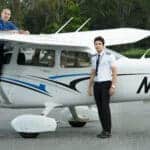

Your first student cross-country flight as a student pilot feels like a big deal—because it is.
You’re finally leaving your local training area, navigating unfamiliar airspace, making real decisions in real time. No instructor by your side. Just you, your nav log, and the open sky.
It’s exciting, but it’s also where many student pilots start second-guessing themselves. Did I plan the fuel burn right? What if I get lost? What if the weather shifts mid-route?
This is where preparation makes or breaks the flight.
In this student pilot cross-country guide, you’ll get the step-by-step breakdown you actually need—from route planning and VFR navigation to airspace awareness and in-flight decision-making. No fluff, no theory dumps—just the real stuff that keeps you ahead of the aircraft and in full control from takeoff to landing.
Whether it’s your dual flight or first solo cross-country, this guide is your preflight briefing—only better.
What Counts as a Cross-Country Flight for Student Pilots?
Before you jump into planning, it’s important to understand what qualifies as a “cross-country” flight—especially if you’re logging hours toward your license. This student pilot cross-country guide starts with the basics, because definitions matter.
According to aviation authorities like the DGCA and FAA, a cross-country flight for training purposes must meet these criteria:
- Minimum distance: The flight must cover at least 50 nautical miles from the departure point to the destination airport.
- Full-stop landing: For the time to count toward license requirements, you must perform a full-stop landing at the destination.
- Dual vs. solo: For solo cross-country flights, prior instructor endorsement is required for each leg. Dual cross-countries are done with an instructor onboard.
You’ll likely log multiple cross-country flights throughout your training, starting with instructor-led routes and eventually moving on to solo legs as your skills grow.
This student pilot cross-country guide is designed to support all those flights—so you know what qualifies, how to log it correctly, and how to approach it with confidence.
Planning the Route – Step by Step
Route planning is where your cross-country flight truly begins. It’s not just about drawing lines on a chart—it’s about understanding terrain, managing time, and avoiding airspace traps. This student pilot cross-country guide will walk you through each step to build a safe, logical, and examiner-approved nav plan.
Step 1: Choose Your Destination
Pick an airport that meets the 50 NM minimum distance and allows a full-stop landing. Your instructor will usually recommend destinations with controlled or semi-controlled airspace to give you a realistic challenge.
Step 2: Select VFR Checkpoints
Use obvious ground references like rivers, roads, railways, or prominent buildings—these are your visual anchors. Checkpoints every 10–15 minutes keep you oriented and let you verify progress.
Step 3: Calculate Heading and Wind Correction
Use your E6B or app to determine true course, apply wind correction angle (WCA), and convert to magnetic heading. Write everything down on your nav log for reference in-flight.
Step 4: Plan Your Fuel
Calculate total fuel required—including taxi, climb, cruise, descent, and reserves. This student pilot cross-country guide recommends adding 30–45 minutes of extra fuel, especially if weather or airspace deviations are possible.
Step 5: Avoid Restricted and Controlled Airspace
Study the sectional chart carefully. Avoid military zones, restricted areas, and busy control zones unless you’re cleared and confident with ATC communication.
Step 6: Choose an Alternate
Always have a backup airport in case weather, runway conditions, or ATC reroutes you. Know how to divert quickly.
With this route planning process from the student pilot cross-country guide, you’ll walk into your briefing with full confidence—and fly like a pilot who knows exactly where they’re going and how to get there.
Documents and Essentials to Bring
One of the easiest ways to ruin your cross-country flight is to show up missing something critical. This student pilot cross-country guide isn’t just about what happens in the air—it starts with what’s in your flight bag.
First, make sure your documents are complete and current. These are non-negotiables:
- Logbook with the required instructor endorsement for dual or solo cross-country
- Valid SPL or CPL student pilot license
- DGCA Class 1 or Class 2 medical certificate
- Aircraft documents (tech log, insurance, weight & balance) — check with your school before dispatch
Next, gather the tools you’ll need for accurate navigation and in-flight decisions. Don’t assume they’ll be in the aircraft:
- Completed nav log with course, heading, ETA, fuel, and alternates
- VFR sectional chart for visual navigation
- E6B or flight computer (manual or digital)
- Kneeboard with notepad and pen
- Watch or timer to track checkpoint intervals
Finally, don’t forget your personal gear. These seem small—but on a solo cross-country, they’re mission-critical:
- Headset (with extra batteries if needed)
- Charged phone and portable power bank
- Sunglasses, snacks, and water bottle
- ID and emergency contact info
This student pilot cross-country guide exists to make sure you walk out to the apron fully prepared—not scrambling to borrow a chart or dig through your bag for a fuel calculation.
Weather Briefing and GO/NO-GO Decisions
Weather is one of the biggest variables in cross-country flying—and one of the top reasons student pilots get delayed or grounded. This student pilot cross-country guide emphasizes this: never compromise on weather. If you’re unsure, it’s a no-go.
Start with a full METAR and TAF briefing for your departure, en route, and destination airports. You want to build a picture of the weather trend—past, present, and future—not just conditions at the time of takeoff.
Pay special attention to:
- Cloud ceiling and visibility (must meet student solo limits)
- Wind direction and speed, especially crosswind components
- Temperature and dew point spread (fog risk)
- SIGMETs, AIRMETs, or NOTAMs for your route
- Enroute terrain and possible convective activity
For VFR cross-country flights, student pilots should never launch into marginal weather. Minimums matter, but judgment matters more.
Use this student pilot cross-country guide to apply a personal safety buffer. If the legal VFR minimum is 5 km visibility, consider 8–10 km as your personal go/no-go standard—especially for solo flights.
And always ask yourself the real question: “Would I feel comfortable flying back through this if I had to turn around?”
Smart pilots don’t push the margins. This student pilot cross-country guide gives you the framework to assess conditions clearly—and delay without guilt when the skies say no.
Flying the Route – What to Expect
So you’ve planned the route, checked the weather, and completed your preflight. Now comes the real test: executing the flight with confidence. This student pilot cross-country guide helps you anticipate what’s ahead—from takeoff to final landing.
Once airborne, timing and awareness become your best tools. Use your nav log to track each leg and confirm checkpoints. Don’t just fly the line—verify your position constantly using visible references.
Here’s what to expect in flight:
- Departure procedures: Maintain proper radio calls, follow ATC or AFIS instructions, and climb to your planned cruise altitude
- Checkpoint timing: Use your watch to mark leg start times and verify you’re on schedule
- Navigation techniques: Use pilotage (following ground features) and dead reckoning (based on heading and time) together
- Airspace awareness: Watch for controlled zones, danger areas, and Class C or D airspace—you may need to request clearance or adjust course
- ATC communication (if required): Stay brief and professional. Announce position reports, intentions, or frequency changes as needed
- Diversion readiness: If visibility drops or you fall off-course, be ready to use your alternate plan—this guide has already helped you plan it
Remember, the examiner or instructor is looking for sound decision-making, not textbook perfection. You don’t need to hit every checkpoint to the second—you need to manage the flight, keep track of your position, and fly with discipline.
This student pilot cross-country guide isn’t just about planning—it’s designed to help you stay ahead of the aircraft, even when real-world variables show up in the air.
Common Mistakes on Student Cross-Country Flights
Cross-country flights are where student pilots prove they’re ready to think and fly independently. But it’s also where small mistakes can snowball—especially without the right habits. This student pilot cross-country guide exists to help you avoid the traps that cause most issues.
Here are the most common mistakes students make—and how to prevent them:
1. Poor Timing Discipline: Many students forget to start their stopwatch at each checkpoint, or they lose track of how long each leg should take. The fix? Stick to your nav log and stay ahead of time.
2. Missing or Misidentifying Checkpoints: Failing to positively identify ground references can lead to disorientation. Use this student pilot cross-country guide to choose checkpoints that are clear, unique, and easy to spot from the air.
3. Violating or Skimming Controlled Airspace: Some students cut too close to Class D or restricted zones without clearance. Study your route carefully, and adjust if needed before departure.
4. Skipping Checklist Items Mid-Flight: In the excitement of navigating, it’s easy to forget cruise checks, descent flows, or arrival briefings. That’s why you rehearse them on the ground and follow a consistent flow in the air.
5. Not Declaring Uncertainty or Getting Help Early: Getting lost or confused is not a failure—failing to speak up is. If you’re unsure, use the 5 Cs: Climb, Communicate, Confess, Comply, Conserve. This student pilot cross-country guide backs that principle all the way.
Mistakes happen, but how you manage them is what defines you as a future pilot-in-command. Prepare smart, fly sharp, and don’t let avoidable errors cost you your confidence.
How to Debrief and Learn After the Flight
What happens after landing matters just as much as what happens in the air. Every cross-country flight is a chance to sharpen your skills—and this student pilot cross-country guide encourages structured debriefing to turn each nav flight into real progress.
Start with a self-evaluation. Ask yourself:
- Did I stay on course and on time?
- How well did I identify my checkpoints?
- Did I manage radio calls confidently?
- Was I comfortable handling unexpected weather or airspace?
Then review your nav log, fuel usage, and any mid-flight decisions. Were your estimates accurate? Did the wind shift more than expected? These insights will help fine-tune your planning next time.
If it was a dual flight, ask your instructor for specific feedback on what went well and what needs work. Don’t just focus on mistakes—note what you handled well too. Confidence comes from recognizing both wins and weak spots.
And if it was your first solo cross-country, reflect on how it felt to fly independently. That’s a milestone worth acknowledging.
This student pilot cross-country guide isn’t just about getting from Point A to Point B. It’s about building judgment, confidence, and habit patterns that will carry you all the way to your checkride—and beyond.
Conclusion
Cross-country flights are where student pilots start thinking like real aviators. You’re navigating solo, managing time, tracking checkpoints, making decisions—and proving to yourself that you’ve got what it takes.
But confidence in the cockpit doesn’t happen by luck. It comes from preparation, planning, and flying with purpose.
This student pilot cross-country guide has given you a full framework—from understanding the rules and building your nav log, to staying sharp in the air and learning from every landing. Now it’s your turn to apply it.
So review the weather. Double-check your kit. Brief your route like a pro. Then take off knowing you’re not guessing—you’re flying with a guide that works.
FAQs – Student Pilot Cross-Country Guide
| Question | Answer |
|---|---|
| How far must a cross-country flight be for student pilots? | For training purposes, it must cover at least 50 nautical miles with a full-stop landing at another airport to qualify toward license hours. |
| Can I fly through controlled airspace on a cross-country? | Yes, but only if you’re trained, endorsed, and confident in radio communication. This student pilot cross-country guide recommends planning around it unless cleared. |
| What happens if I get lost during the flight? | Follow the 5 Cs: Climb, Communicate, Confess, Comply, and Conserve. Always have an alternate route pre-planned using this student pilot cross-country guide. |
| Can I use GPS during my cross-country? | GPS is helpful, but as a student pilot, you must demonstrate pilotage and dead reckoning. This guide emphasizes using visual references and timing. |
| Do I need to file a flight plan? | In many cases, yes—especially for solo flights. Your instructor will advise. Always follow your school’s procedures as outlined in this student pilot cross-country guide. |
Contact the Florida Flyers Flight Academy Team today at 91 (0) 1171 816622 to learn more about the Private Pilot Ground School Course.